

DOJ Trade Fraud Task Force Hits $1 Billion Milestone in Short Order
- July 15, 2026 by Alexander Owens
- Federal False Claims Act
On July 14, 2026, the Department of Justice (DOJ) announced that its Trade Fraud Task Force (TFTF) had exceeded $1 billion in recoveries and charged losses, a remarkable figure considering that the TFTF was established just under a year prior in August 2025. The TFTF attributed its output to a mixture of “rigorous criminal prosecution and civil enforcement under the False Claims Act (FCA),” confirming that whistleblowers continue to turbocharge enforcement in the customs arena. In fact, the DOJ specifically highlighted its recent $549.5 million recovery in a case against Perfectus Aluminum and $54 million recovery in a case against Ceratizit USA, both of which originated from qui tam (whistleblower) complaints.
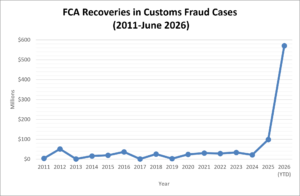
The government’s announcement may actually undersell just how quickly enforcement is growing. For example, data on customs fraud recoveries in FCA cases shows a marked uptick in recent years, up over 1,770% from five years ago. In fact, FCA customs fraud recoveries in just the first six months of 2026 are greater than recoveries in all prior years combined. And because FCA cases typically spend several years under seal, these figures are lagging indicators—so today’s high-water mark may not remain a record for long.
DOJ also used its announcement to put all those within the supply chain on notice that the government is not just focused on importers of record, the classic targets of trade fraud enforcement actions. DOJ emphasized that the TFTF also polices “customs brokers, downstream distributors, industrial and commercial end-users, and other supply-chain actors who knowingly profit from merchandise imported contrary to law.” DOJ also made its public policy case for robust trade fraud enforcement: ensuring the country’s fiscal health, creating a level playing field for domestic companies that play by the rules, and protecting public safety.
The government is not slowing down either. DOJ simultaneously announced that it was creating a new division within the National Fraud Enforcement Division focused on the prosecution of criminal trade fraud and related offenses, the Global Trade & Commerce Enforcement Section (GTCES).
Finally, the TFTF issued “A Resource Guide to Trade Fraud Enforcement,” a comprehensive, 27-page handbook setting out the TFTF’s wide-ranging priorities and highlighting key examples of civil and criminal enforcement actions. The guide makes clear that while the TFTF remains highly interested in classic customs fraud typologies like undervaluation, misclassification, and transshipment fraud, the TFTF’s jurisdictional reach goes far beyond those bread-and-butter schemes, covering everything from port shopping to forged product safety certifications. In total, the guide details 16 different fraud typologies:
- Manifest Fraud
- False Country of Origin (COO) Declarations and Markings
- False HTS Classification
- Undervaluation
- Anti-Dumping/Countervailing Duty (AD/CVD) Evasion
- Shell Company Fraud
- Customs Broker Fraud
- Drawback Fraud (False Export Claims)
- Free Trade Agreement (FTA) Fraud
- Port Shopping
- “Prior Notice” and Import Alerts Evasion for Regulated Food
- Forged Product Safety or Environmental Certifications (e.g., CPSC/EPA Fraud)
- Failure to Report Dangerous or Defective Products or Adverse Events
- False Declaration of Regulated Commodities
- Illegal Timber and Wildlife Laundering (Lacey Act, Endangered Species Act, & Others)
- Importing Adulterated Drugs and Devices
The message to the trade and logistics sector leaves no room for ambiguity: there is an extensive patchwork of trade laws, and regardless of your role in the supply chain, DOJ is not handing out free passes to wrongdoers. Meanwhile, given that the TFTF is focused on a range of criminal trade fraud actions—many of which involve typologies falling outside the traditional ambit of the FCA—DOJ’s Corporate Whistleblower Program offers another key avenue for trade fraud whistleblowers.